how do germans see americans?
Note: Everything in this post is as of 2024. Of course, what it means to be American has taken on a different dimension since then, and I cannot speak to whether or how Germans regard Americans differently now.
One question that naturally held sway in my mind while I was living in Munich in 2024 is the question of how Germans see Americans abroad. How do I come across? How much does my culture color people's perception of me, and what exactly is it that they think of when they hear I'm an American? This question returned suddenly to my brain recently when I was playing a video game (Legend of Zelda)1 whose language setting I had changed to German, and encountered a character who had an American accent.
To be clear, as one progresses through the early stages of this game, few characters have voice actors at all. Zelda herself speaks in delicate tones, with the 'proper' standard pronunciation one might expect from a princess, and the two other voiced characters are the "Old Man" and Impa, who both speak in voices marked more by age than any other trait. Yet a little later on, one meets a new character, Prince Sidon, the first character I've ever encountered in media whose spoken German sounds like mine.
I was amazed. No matter how hard I try, this is how German sounds when it comes out of my mouth. This was the first time I'd ever heard this accent not on myself or on other Americans learning German, but on someone – even a fictional character – who speaks eloquently, with no grammatical mistakes, and yet still with a clearly American inflection.2
But this raises so many questions. What did the creative director of this game mean when they decided that Prince Sidon should have an American accent? What does an American accent connote? I will say that Prince Sidon is a very enthusiastic, extroverted character. When you first meet him, he is utterly delighted to encounter "einen Hylianer," even performing a backflip into the water upon saying goodbye. (He is a member of the Zora, a race of aquatic-dwelling mer-creatures.) He is dressed well, of course (being a royal), and flashes grins in which his teeth sparkle. Making the smallest bit of progress on the quest he's invited you on causes him to reappear, offering effusive encouragement. Rather an over-the-top fellow.
But this is how we come across abroad, isn't it? Americans are extroverted, Americans are overly sociable – these are all things I've heard many times before in other places.
As to whether this is true --- I wonder if this stereotype originates in the fact that we simply move around a lot. Germans traditionally make their close friendships growing up, and retain that set of friends over their entire lifetime. In contrast, it is much more normal for Americans to move cities multiple times in their lives. In a new setting, you have to put forth a great deal of extroverted social effort to make friends, otherwise it will simply not happen.
The other thing is that in this video game, Sidon offers more encouragement than you likely need. In Germany, when I had just recently joined a group of beekeepers, we once had to split the hives, a task that required three hours of outdoor manual labor. At the end of it, I said to everyone, "Gut gemacht," ("well done,") and one member of the group told me "In Germany we don't say gut gemacht, we just nod."
Dang. After all that effort? Is it partly because this beekeeper is a man that he has this closed-off, minimal recognition of achievements, or is German culture overall just not expressive in that way? I asked the leader of beekeeping about it later, and he told me "no, I should have said gut gemacht."
Today, at a rock-climbing gym, I was surrounded by children between the ages of four and six and their parents, all of whom expressed praise over their children's achievements. Some took videos of their children's climb, to show to their spouse. German parents do not really do that. I thought back to first and second grade, when everyone in my class would get a sticker on their homework just for turning it in. "We don't give stickers in first grade," this boy had told me.
It is like a motivational thing, isn't it? For German children, it seems like they're just assumed to have natural reserves of intrinsic motivation. Motivating yourself becomes your job, not that of the adults around you. I suppose it might teach children to be more independent, to do assignments themselves and to do them well because it is the right thing to do. But it still feels… lonelier. A little sadder. I want someone to congratulate me after I've put in a great deal of hard work, even if that is an "American" thing to expect.
Returning to the original topic, I've decided to post a series of photographs I took during my time living in Germany in 2024. The hope was to assemble a collection that would answer the question "how do Germans think of Americans?" although I think these are too fragmented to have really achieved that. These pictures are not particularly artfully taken, they were very much in-the-moment as I tried to figure out, taken together, what they mean.
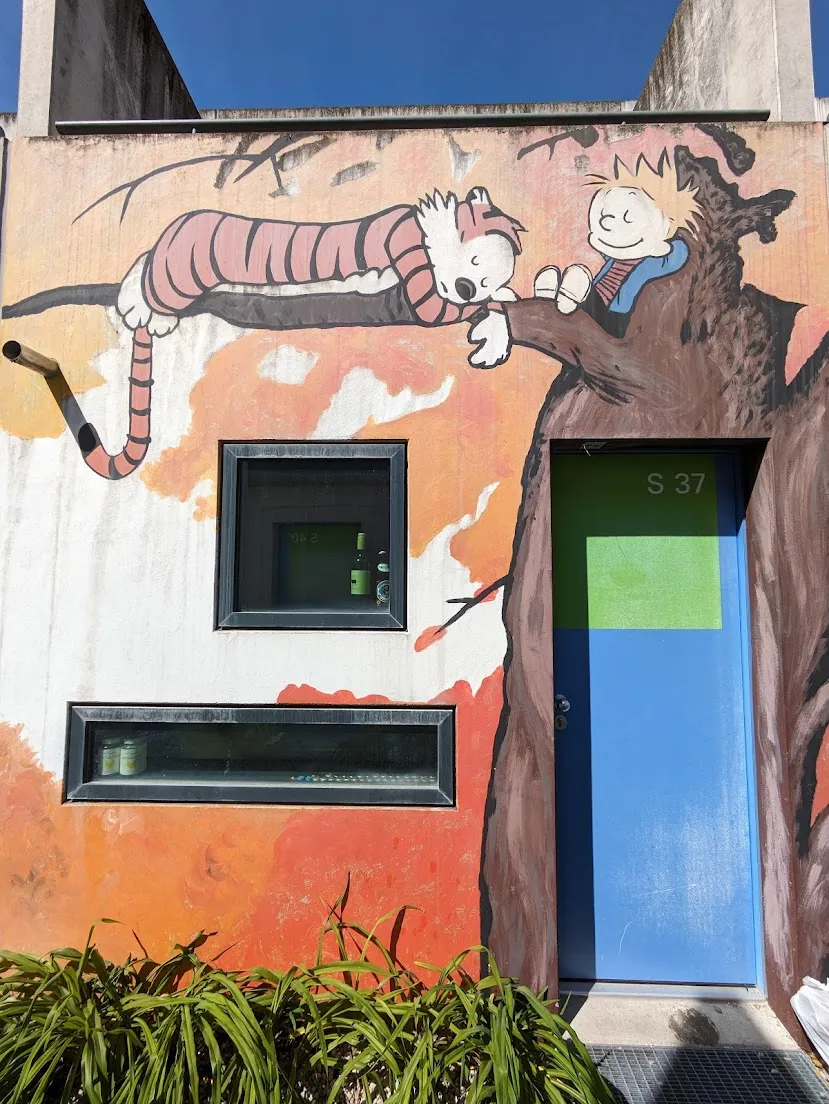
Calvin and Hobbes. American pop culture, in translation, is very popular in the German-speaking world, and characters from The Simpsons as well as the Mario franchise were very commonly featured in how the college students of my neighborhood chose to paint their homes. Calvin and Hobbes, though, was something I did not expect at all to see.
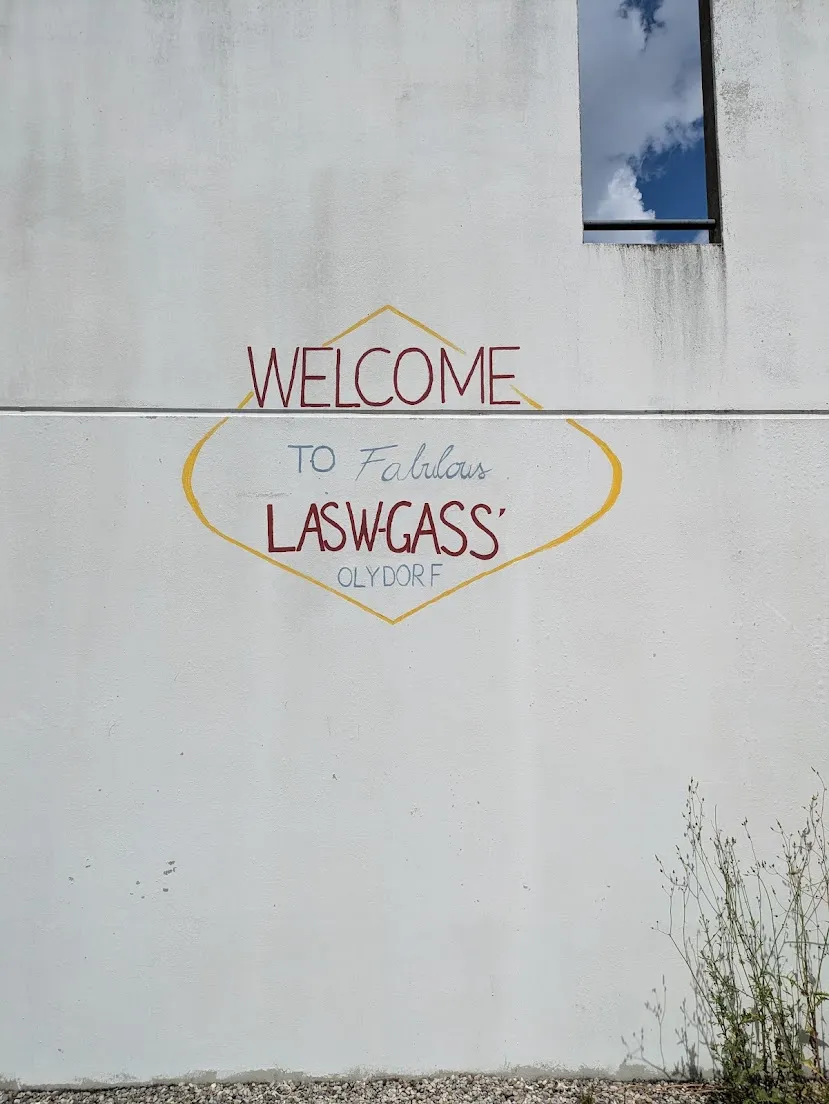
Welcome to Fabulous Las W-Gass'. In Olydorf, the neighborhood is organized into rows (the word for a row or narrow street is Gasse), and each is marked by a letter of the alphabet. The W row, then, is the W-Gasse (or W-Gass', pronounced: Ve-Gass.)
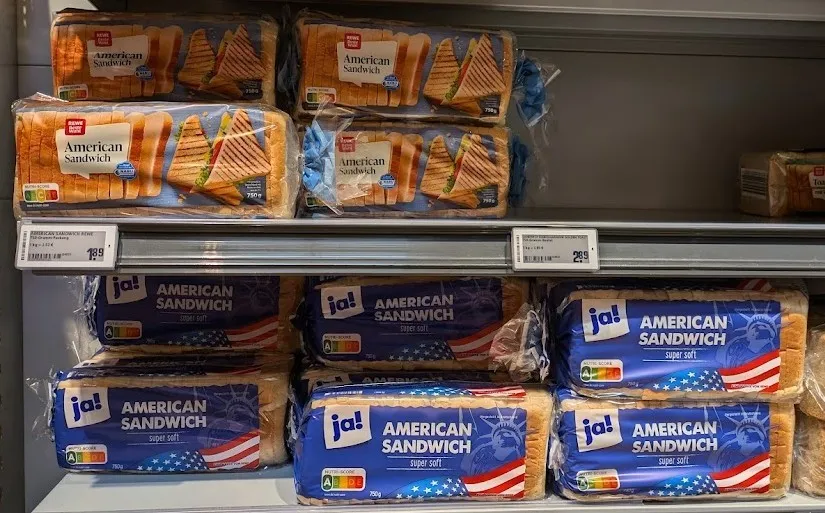
Okay, so we know Germans are very, very proud of their bread. And rightfully so – what you buy from a bakery, fresh, is excellent bread. But somehow… in this land where everyday life is dependent on quality bread… supermarkets have their own section of white bread filled with preservatives. They call it... "American Sandwich."

While the Americans are drinking Sam Adams, the Germans are drinking… George Washington?
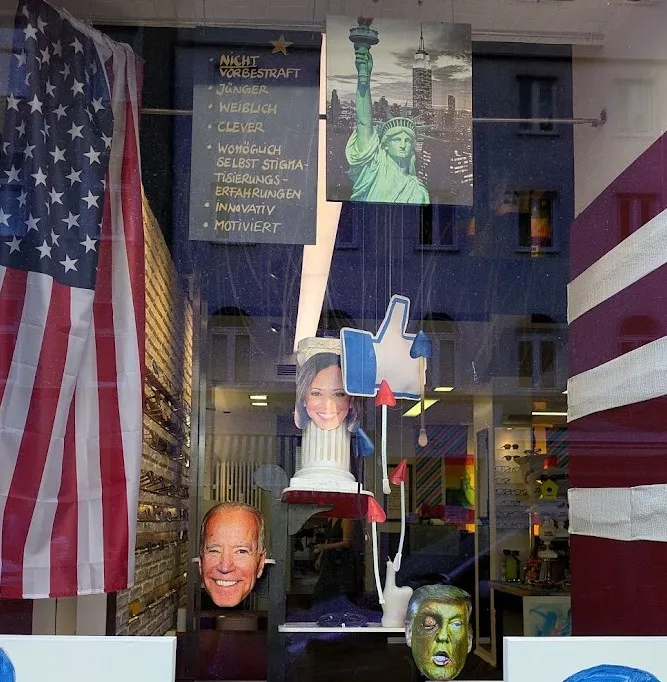
I did a double take when I walked past this shop window, as I think anyone would. (Picture taken during the summer of 2024.) The bullet points read:
- Not a convicted criminal
- Younger
- Female
- Clever
- Might know what it's like to be discriminated against
- Innovative
- Motivated
It's the window of a glasses shop, and it took me a while to realize why they put up this display. "Put on some glasses, you'll see the world more clearly!"
I've cropped the photo a little because the display towards the bottom was weirder. The Germans have a longstanding tradition of political satire through papier-mache, which takes the form every year of floats in a parade at Karneval (although the floats are often crass.) I did appreciate these collections of 2026 floats, especially the one showing the AfD as a remote-controlled drone being operated by Putin.

When Taylor Swift came to Munich for her 2024 Eras tour, a guy with a guitar stayed outside the Olympia-Stadium after the concert was over, playing her songs with a crowd circled around him, singing along. It started to rain, but no one moved. It started to rain harder, with thunder and lighting, and people started to seek shelter, but still he kept playing, and these two girls brought a blanket to cover him. Her music means that much to people.
All of this is to say… the Germans are thinking about us, like, all the time. I remember on the day Kamala Harris first picked her running mate, I woke up, walked into a Munich bakery, glanced at the headline of the local newspaper, and it read "HARRIS ENTSCHEIDET SICH FÜR WALZ."3 And yes, they are sad about... the same things left-leaning Americans are sad about. But on an individual basis we are all just people. And being typecast as people who are highly-extroverted and overly generous with encouragement is really not a bad stereotype to have.
It was Breath of the Wild for those who are curious.↩
It is a bit hard to describe… it feels like I am slinging my vowels around more in my mouth. Or perhaps I am speaking too much with the front of my mouth? Do Americans open their mouths more with short vowels than native German speakers? (If I was sure of the answers to these questions, I'd be able to work on my accent more, wouldn't I?)↩
"HARRIS DECIDES ON WALZ"↩